Years like this one, where we have the yamim tovim chunked together with the weekends, are — dare I depart from our love of kvetching and say it? — a little easier for most of us, at least in terms of holding onto routine.
Instead of the days fluctuating in a never-ending school – Erev Yom Tov – Yom Tov – school – Erev Shabbos – Shabbos – school – Erev Yom Tov cycle, we have almost full weeks of school between each chag. This is good news: it means that we are starting off each yom tov with our reserves of patience and energy at least somewhat replenished.
All that said, this season is still one of the most taxing ones of the year, what with the unsettled-ness of a new school year mixed together with lots of unstructured time and late nights (and for us parents who are making the yamim tovim, also lots of hard work and expenses). To make it a little easier, we’ve compiled some resources and ideas below.
Wishing you a gmar chasima tova and chag sameach!
Erev Yom Kippur
Kapparos has been done (and maybe a rushed tashlich, too, at the kitchen sink, for those of us who haven’t made it to a body of water all week), the seudah hamafsekes is ready to be served, and everyone (mostly) has showered and changed into yom tov clothing.
Tatty dons his white kittel and he and Mommy begin to emotionally bentch each of their children with the traditional bracha: Yisimcha Elokim… V’yehi ratzon… May your mouth speak wisdom… May your hands engage in mitzvos… May He grant you righteous sons and daughters who engage in the Torah… Amen.
One by one, they bless each child, and then Tatty and Mommy approach their special neshama and place their hands on his head, but the words get stuck somewhere between their hearts and their lips… Because this Erev Yom Kippur bracha was composed for a child who will, with Hashem’s help, blossom into an independent adult one day, while the child that they currently face is limited. And although they know intellectually that this child was created this way purposefully and that he has his own unique path in life, they still struggle to articulate the words of the bracha.
Rebbetzin Esti Hamilton, the mother of an adult son with special needs, faced this same challenge — so one year, she sat down with rabbanim and composed a beautiful bracha that encompasses all of the things that parents of a child with special needs want to bentch their child with. She has generously shared a printable PDF version of her Erev Yom Kippur bracha with us for you to make use of! Click the button below to download.
!!!Reminder!!!
Usually, before yom tov, we use our newsletter as a platform to share tips about schedule management, sensory overload, and realistic expectations. This time, we want to give you a reminder about the thing you forget the most: Not the shopping, nor the cooking, nor the relationships with your various family members. You.
But I have no time or mental energy for self care! My child thinks night is day. My family thinks I’m a snack machine. I fall asleep before my head even touches the pillow.
We get it. The last thing you want is someone to tell you to get a manicure or latte that you have no time for and maybe also can’t afford, while you paste on a smile and tell them that baruch Hashem, you are doing just great.
What we’re suggesting doesn’t take time and doesn’t cost money, it just takes some intention. Life has a way of getting blurry; when we’re just so exhausted, we can go through the motions of caring for our families and ourselves through a disconnected haze. At times like these, we tend to get so stuck on the noisy distractions that the background music doesn’t register.
This Sukkos, try to tune into the experience of life’s moments and feel Hashem’s bounty. A child is showing you the decoration she made — notice her shining eyes, her pride in her accomplishment, and appreciate the skills that she’s mastered and applied to her handiwork. You’re eating hot chicken soup in the cool sukkah — close your eyes and focus on the sensory experience of the salty, flavorful soup slowly warming your insides as you swallow. It’s self care, it’s mindfulness, and it’s gratitude to Hashem. You don’t need to set an amount of times you do it per day or anything — it’s not a kabbalah, it’s a gift that you are giving yourself. And you deserve it.
For Yom Kippur and Sukkos: A Father to Fathers
A father of two children with special needs wrote a yom tov message for his fellow fathers, which we are sharing below for all of our incredible Ezreinu dads:
I want to speak as a father. Not as a Rav, not as an expert. As a father of two special children.
When I was a younger father, I thought my job on Yom Kippur was to be perfect. To daven the whole Yom Kippur without distraction. To come home and be a malach, a perfect, patient father.
And every year I failed. Because my children need me during Ne’ilah too. My wife needs me to switch. Sometimes my child has a meltdown in shul. I leave early. I come late. I fall asleep on the bench because I was up all night.
For years I thought that meant I wasn’t doing Yom Kippur right.
And then one father older than me told me: “The Kotzker says, what does Hashem want from you on Yom Kippur? Just to be truthful. Your Avodah is the child you are holding.”
Yom Kippur is not about pretending we are angels. It’s about admitting we are human.
We are not atoning for being bad fathers. We are atoning for the impossible standard we set for ourselves. For the anger that comes from exhaustion, not from evil. For the moments we resented our shlichus.
On Yom Kippur, Hashem doesn’t ask us to be like other fathers in shul. He asks us to bring our ledger, with the extra appointments, the therapies, the IEP meetings, the sleepless nights. That IS our Viduy. That IS our Avodah.
And then right after Yom Kippur, Hashem says: “Now leave your perfect house and go into a Sukkah.”
What is a Sukkah? A Sukkah is not accessible. It’s not sound-proof. It’s not perfect. The wind blows in. The sechach falls. It’s temporary and fragile.
It’s our house.
Sukkos teaches me that holiness is not in control – it’s in vulnerability. We build a beautiful Sukkah not because it will last forever, but because we do our best, for now. That’s our parenting too.
We don’t get the sukkah we planned on. We get the sukkah we got. And Hashem says, “I want to dwell in this one.”
So what do we do as fathers?
Two things I learned late:
1. Let the Sukkah have holes.
Your kids don’t need a perfect father. They need a present one. On Sukkos we invite the Ushpizin – Avraham, Yitzchak, Yaakov. I now invite other fathers in too. I stopped trying to do it alone. Call one other father this Sukkos. Say, “It’s hard.” That is more holy than any esrog.
2. Self-care is not selfish. It’s pikuach nefesh for the family.
We talk about self-care for mothers – which is so important – but fathers don’t give ourselves permission. We think if we go for a 20 minute walk alone, or learn for 20 minutes, or go to the mikveh slowly, we are abandoning our post.
We are not.
On Yom Kippur we fast. On Sukkos we feast. Our neshama needs both rhythms. You cannot pour from an empty cup. If you burn out, there is no father, no husband.
My self-care is not going to Miami. It’s small: Every day I put on tefillin without my phone. I walk around the block once without being called. I do one thing that makes me feel like me, not just “Abba of.”
If you take care of yourself, you are not taking away from your children. You are making sure you are there for them in 10 years too.
So before Ne’ilah this year, before you say “we are Your children” – Ki Anu Bonecha… – remember, you know what it means to love a child who can’t always say thank you back. You know what unconditional love is.
Hashem is looking at us fathers and saying, “You really know what it means to be a father.”
Gmar Chasima Tova, and a Sukkos filled with real, imperfect, holy joy!
May we all be able to sit in our Sukkahs and just be – with our wives, our children, and with ourselves.
Get ready, get set, yom tov!
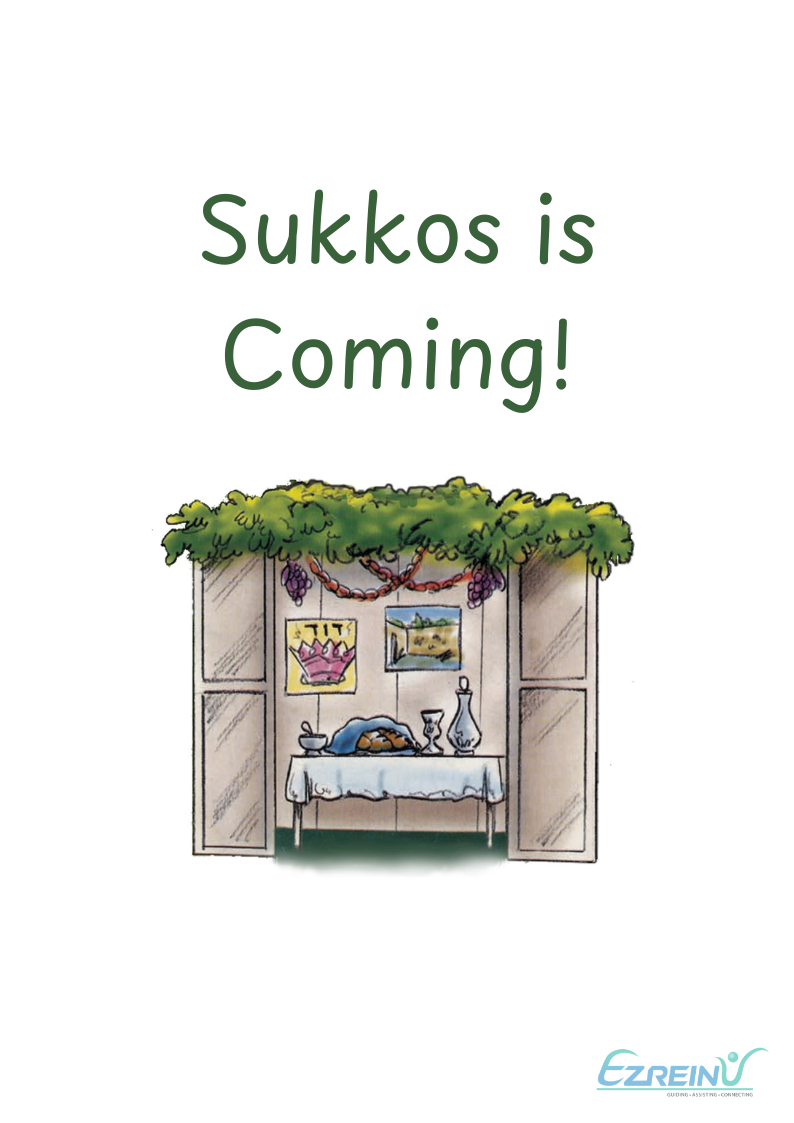
While we prep for yom tov, it pays to take a break to discuss the upcoming changes with our children. Most kids with special needs find change more unsettling than exciting, but if you give them an idea of what’s coming, that can offer a measure of stability. Download and print out our adorable social stories for Yom Kippur, Sukkos, and Simchas Torah!
You can always use some more resources
That’s why were here: to be a resource center for you. Also, to send you newsletters a couple of times a month. Enjoy this previous yom tov season newsletter, full of practical tips to get you through Tishrei: Update from Ezreinu #19 – V’samachta: how to make your chag a happy one – Ezreinu Services