I will never forget the time in class when I was assigned to watch Shimmy, an adorable, nonverbal little boy with Autism, on the day that we were making ice cream. Shimmy was allergic to dairy, so while his classmates vigorously shook their bags-of-ice-cubes-with-little-bags-of-sugary-milk-inside to make the sweet treat, Shimmy ran ‘round and ‘round the classroom with abandon, cheerfully flapping and rocking to his heart’s content, apparently completely unaware of the frenzied ice-shaking going on at the tables on the side of the classroom.
Until the moment that he approached me, lifted his tablet, painstakingly tapped out that sentence — “I! Want-to! Eat! Ice-cream!” — and looked me squarely in the eye.
I shook my head in amazement as I went to the pantry to see if I could find an alternative treat that would satisfy him. Shimmy knew, really knew, everything that was going on around him! He might have struggled to orate his thoughts, feelings, and needs, but thanks to his AAC device, he was able to communicate.
It’s difficult to imagine a scenario in which Shimmy would not have had access to the device (and the training to go with it). One sad little boy would have seen everyone eating ice cream but him — and his teachers, who are supposed to help him, would have been oblivious to the issue as he’d continue to happily run ‘round and ‘round, betraying none of his true feelings.
Basic Background
AAC, or Augmentative and Alternative Communication, refers to any additional method of communication outside of oral speech. It includes physical gestures and signs (think, a thumbs up, nodding “yes” or “no”, or pointing at a desired item) as well as something called “aided AAC”, which relies on physical items such as picture cards (like PECS) or electronic technology.
When people say “AAC device”, they are usually referring to the latter option, which comes in many different forms and combinations of hardware and software, designed to meet the needs of each individual user.
I can understand my child without help, thanks!
When a teacher or therapist broaches the option of an AAC device, it’s not unusual for parents to be taken aback. But my child does speak a little! I don’t want to hear a computer talking instead of him. He knows how to point; I can usually figure out what he needs. While these thoughts are certainly valid, here are some considerations to keep in mind:
Communication doesn’t only involve expressing needs (I’m hungry). It includes sharing thoughts and feelings (I had a hard day), commenting (It’s raining!), questioning (Are we going to Bubby today?), and so many other forms of social interactions that us — thankfully! — verbal folk take completely for granted. Giving a child tools to access all of these levels of communication is an indescribable gift.
Even for a child who is capable of talking, many find it easier to use an AAC device, either conjunction with or instead of oral speech, when they have that option. Many devices will show the words that the child is looking for, which can be very helpful for those who struggle with executive functioning or word retrieval. So if we can, why not make life easier for a person whose life is already so challenging?
But will it stunt my child’s oral speech development?
Ah, the million dollar question!
And the answer, according to scientific research that was conducted to specifically prove that it would indeed stunt oral speech, is a resounding NO.
No, using an AAC device has not been shown to decrease oral speech. (In fact, speech therapists will often tell you that they’ve seen more oral speech develop after teaching a child to communicate via AAC.)
Human nature is to communicate in the easiest and most accessible way possible. So if a child is choosing to communicate using a device instead of his vocal cords, we can assume that this is the easiest option for him — let’s respect his choice.
The thing is legit his mouth
“Bike. Helmet. Bike Helmet Helmet-Helmet-Helmet-Bike. Bike. Bike………Bike. Helmet. Bike.”
If you’ve been around children who communicate using AAC devices, the above (or the same pattern with other words) probably sounds very familiar. It’s what most of us would call “stimming” — repeating words over and over for no apparent reason at all; certainly not to communicate anything. After hearing the grating helmet-helmet-bike refrain for 10 minutes straight, we might find ourselves, against our better judgement, ordering said child to “stop stimming” already.
And in doing so, we may be failing to realize something fundamental: for this child, his tablet is his voice.
You know how the average baby babbles incoherently for any length of time before shaping her cute little noises into actual, comprehensible words? Would you tell her to stop? She’s practicing vocalizing so that one day, she’ll be able to speak. She’s exploring her world. She’s imitating the people around her and displaying social awareness. She’s trying to add her two cents to the conversation. We understand that making meaningless noise is part of the natural process of acquiring speech.
Here’s a simple perspective turnaround to apply: change the label for this bike-bike-bike behavior from “stimming” to “exploring”. Your child is practicing vocalizing so that one day, he’ll be able to speak. He’s exploring his world. True, he’s not communicating right now. You can even tell him that, and ask him to please lower the volume on his device. This is a teachable skill. Say, “Sweetheart, right now you are talking to yourself; please lower the volume.” But don’t put a stop to it. Let him use exploration as a means to get to know his device and learn how to better use it to create social interactions.
With the recognition that an AAC device is, for many, the equivalent of the user’s voice, we have another important pointer to keep in mind: Shabbos use. There are different opinions as to whether there is a heter for someone to use an electronic AAC device on Shabbos; while some rabbanim rule against it, others are more lenient. Consult with your family rav as to whether it would be permitted for your child.
I’m an *awesome* communication partner!
With all of the wonderful advances in communication that nonverbal (and somewhat-verbal) children can make with the aid of AAC, it’s important to remember that progress is a long process, and no one goes from nothing to everything overnight — or even over weeks and months.
What can you do to help things along? One thing that AAC users consistently need in order to develop their skills is committed “communication partners” — in other words, you!
Being a good communication partner means a lot of things. It means having patience while your child labors to formulate phrases. It means showing fully involved interest with your body language and words. Most importantly, though, it means recognizing that the language your child is speaking now is the language of the software on her device, so if you can speak “her language”, you’ll make things easier for her. You can do this by physically modeling use of the AAC device as you speak.
While you speak, you can pair words with their meanings by showing the object or action (e.g. showing an apple as you say the word “fruit”, pretending to run when you say “go”, etc.).
While these are things your child’s speech therapist should be working on with her consistently, going the extra mile by being a supportive communication partner will help reinforce your child’s comprehension and vocabulary.
There are too many choices to choose from… Help!
From LAMP to Proloque2Go to TD Snap, choosing the right AAC device and software is a decision that should be made only with the help of an experienced speech therapist who specializes in AAC. Have them conduct a thorough assessment. They’ll measure your child’s linguistic ability, navigation ability, and many other relevant skills, and make a recommendation based on the outcomes. There are options out there that can accommodate children who struggle with physical movement and/or fine motor by utilizing switches, eye-gaze, or other means, and an experienced therapist should be able to recommend the program that would be the best fit.
Uh… How do these things run, like, price-wise?
I knew you would ask that… These things run kind of pricey, like thousands-of-dollars type:(
Many of the companies that produce AAC devices and software will allow you to run a free trial before ordering the device. Funding may be available through the board of ed or your child’s insurance — this is a discussion to have with the school and with the company you are buying the device from, as many of them bill insurance providers directly. You will likely need to provide copies of the AAC assessment (and if there are physical access needs, a copy of an OT’s assessment as well) to get financial coverage — the evaluating therapist(s) should be able to provide you with this documentation. One more thing — if you already have an iPad/tablet, you may be able to install just the software for a much lower price (three-digit instead of four) than the purchase of a new device.
With much appreciation to Miri Shaffer, MS, CCC-SLP for generously sharing her knowledge with us for this newsletter. Miri has many years of experience as a speech language pathologist specializing in AAC. Her private practice can be reached at (347) 450-9750 or info@LetsTalkNY.com.
We are so excited to announce our new Whatsapp-based support group for parents who have children living in, or are considering placing their children in, residential settings (including group homes, residential schools, etc.). Join our group by clicking the button below!
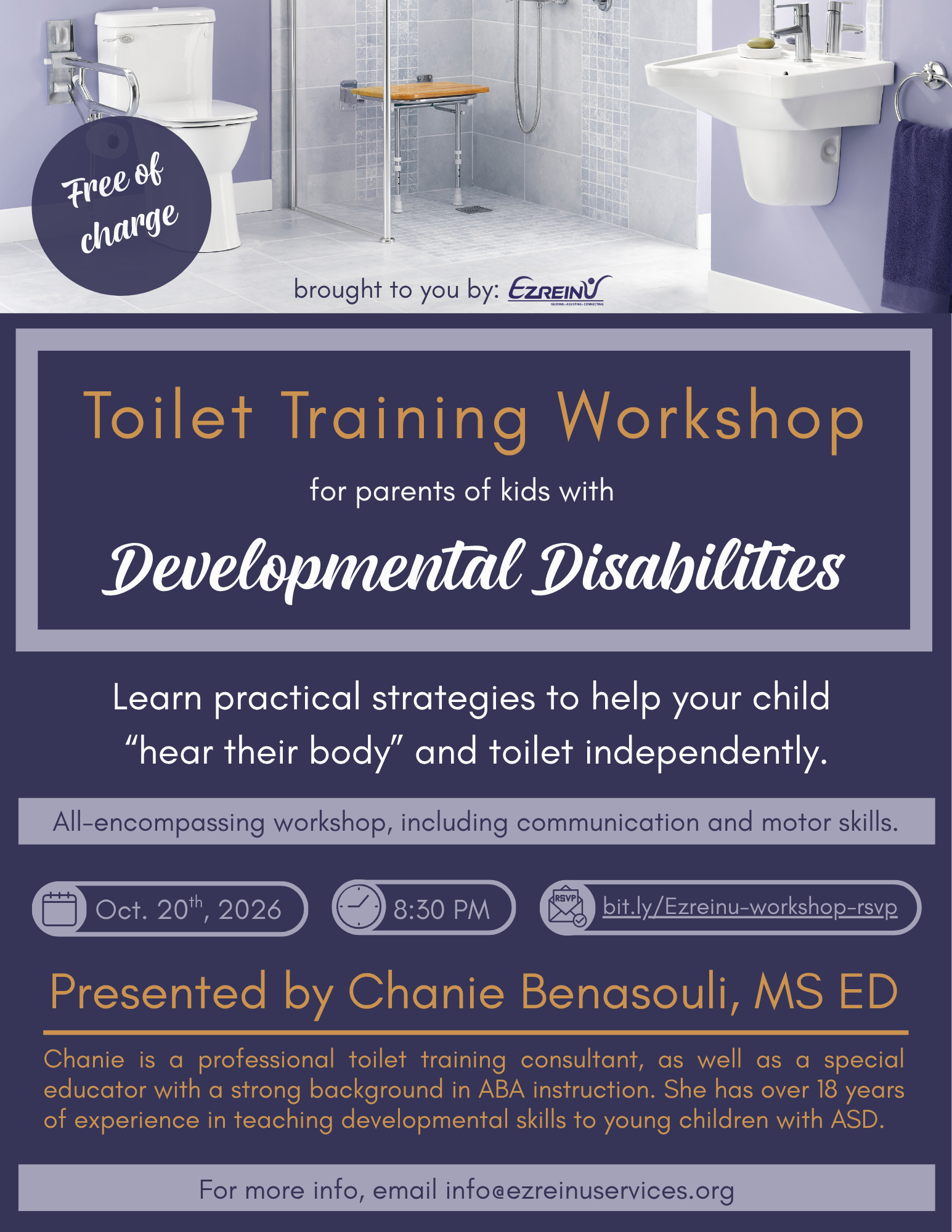
This week, Ezreinu hosted an informative toilet training workshop for parents of children with special needs. Chanie Benasouli, an educator with many years of experience teaching daily living skills to children with ASD, gave a fantastic and well-received presentation to 150 live participants!
The recording will be available shortly to those who registered for the workshop — keep your eyes open for an update!
Mrs. Zalmanowitz was searching for ways to keep Bracha, her adult daughter with special needs, occupied over the long Sundays. Bracha had funds through self-direction to pay for community classes that she would enjoy, such as swimming and music, but Mrs. Zalmanowitz didn’t know of any local options that could service her, so she called Ezreinu — and received information about several nearby classes which accepted self-direction and would keep Bracha gainfully occupied every Sunday!
Chesky, an adorable 6-year-old boy with ASD, had been receiving ABA services from a specific agency for the past year, when one day, the agency called Chesky’s father and informed him that they would no longer be accepting their insurance plan. Paying for the service out-of-pocket was far too expensive, so Chesky’s father reached out to Ezreinu, and received contact information for a different agency which did accept their insurance plan and would be able to service him going forward!
Identifying details have been changed to protect client confidentiality.
Liked this post?
Sign up to receive bi-weekly updates to your inbox.