Goodbye, summer. Goodbye, long, sunshiny days, camp, swimming, fun. See you next year!
Okay, so the days are still kinda long and sunshiny. On leap years like these, the early start to the frum school year means that fall is not quite around the corner. But you have to admit, there’s something crisp about September, even if it’s still oppressively humid out there. The school hallways smell of fresh paint, backpacks are stuffed with sparkling supplies, and kids hobble along in their stiff, new shoes… Another fresh start. Whether they’re in a mainstream or special ed setting, we all want to set our children up for success this year.
Learning and Vision
Many of our children grapple with traditional classroom learning; while everyone else except for my kid plenty of other children seem to absorb skills like reading and writing by osmosis (okay, fine — by listening well, understanding well, and following directions well, too… But this truth only makes it more painful), kids like ours are struggling.
Though learning difficulties are always made up of multiple components, one of the more significant factors is visual processing — or lack thereof. When a student is having trouble with their vision, it unquestionably affects their ability to perform in the classroom. How can a child who can’t see the board or the worksheet in front of them be expected to learn how to read and write fluently?
Even if a child already has glasses — or doesn’t need glasses at all — he can still experience visual difficulty with things like focusing, tracking, or depth perception. By looking at your child’s eyes carefully, you can often see yourself whether they are misaligned or unfocused. If you suspect a vision issue, consider bringing your child to a skilled eye doctor for an exam before you get too deep into the school year.
What type of eye doctor should we see?
There are various types of specialists who treat the eyes, such as ophthalmologists (medical doctors who specialize in eye health and can do surgery if needed) and neuro-ophthalmologists (medical doctors who specialize in brain-related vision issues), but the commonly used term “eye doctor” usually refers to optometrists, who treat eye-related vision issues by conducting eye and vision exams and prescribing eyeglasses or other visual interventions.
You may have heard the term “behavioral optometrist” or “developmental optometrist” thrown around; this refers to optometrists who focus (ha, ha) specifically on how vision affects development, rather than getting stuck at the prescription number. Many of the optometrists who provide vision therapy (whether or not these patients need prescription lenses) are known as developmental optometrists.
Who should go for vision therapy?
Vision therapy consists of various exercises and activities done consistently, which are used to strengthen eye muscles and train the eyes to work together efficiently, improving focus and decreasing the need for reading glasses, prism glasses, or other crutches.
Participating in vision therapy takes a large dose of commitment and motivation from the patient, as well as a cognitive level capable of following basic directions and providing verbal feedback on how their eyes “feel” while following the prescribed regimen. Though for very young children, an optometrist can suggest some simple home-based activities to improve tracking or convergence, a child below the cognitive level of approximately age 5 might not be a great candidate for clinic-based vision therapy sessions. That said, as children grow older and wiser (read: less bribable), it may become more difficult to obtain their cooperation at sessions in the clinic and at home. The general rule of thumb is: the younger you start, the better.
K, but how do I know that vision therapy is legit?
In our our society’s media, vision therapy is heavily advertised as the answer to all issues, whether academic, behavioral, or physically functional. If you have an inner skeptic like me, you might find yourself rolling your eyes when you come across these ads. Overpromising is manipulative to desperate parents, which is really not nice — and for almost everyone else, it simply doesn’t sell.
If you do a bit of basic online research, you’ll discover that vision therapy is not officially evidence-based as an effective treatment for learning disabilities. The only area of vision therapy that is backed by enough scientific research is when it’s used to correct convergence insufficiency. (Convergence = the way the eyes come towards each other, or cross, to focus on nearby objects. Ergo, convergence insufficiency = not sufficient convergence, or simply, difficulty focusing.)
But here’s the scoop: the reason that there’s only scientific evidence of vision therapy for convergence insufficiency is because that is the only area that was studied significantly. Optometrists (who are generally not quacks, but run-of-the-mill, educated, and trained doctors) will tell you that they do see significant improvement when using vision therapy to treat many different vision issues that affect patients in various areas of functioning, including classroom learning in school-aged children.
Vision therapy is a bit controversial as it doesn’t always bear fruit, but then again, therapies such as speech therapy or occupational therapy also sadly don’t always bring about the big results we hope for. If the clinician providing the vision therapy is skilled and experienced and the child is coming for a real and not imagined vision issue (and the regimen is followed consistently), most parents do see slow but steady progress.
It’s best to go to an optometrist or vision clinic that was specifically recommended to you by a professional who knows your child, such as your child’s pediatrician, classroom teacher, or OT. You don’t want someone who has an agenda; you want someone who will examine your child carefully and skillfully, and who will only recommend intervention that is actually likely to help, whether that be prescription glasses, patching, or vision therapy.

With much appreciation to the following professionals for generously sharing their knowledge with us for this newsletter:
A clinician at SUNY Optometry’s University Eye Center: The University Eye Center, located in Manhattan, provides optometry and vision therapy services for adults and children, including children with special needs. The University Eye Center accepts insurance. Appointments can be scheduled using their online form here: Schedule An Appointment – University Eye Center | SUNY College of Optometry
A clinician at Ahava Medical: Ahava Medical (locations in Williamsburg, Flatbush, Inwood, Monsey, and Liberty) provides optometry and vision therapy services for adults and children. Ahava Medical accepts insurance. Appointments can be scheduled using their online form here: request-appointment – ahavamedical
Fraida Flaishman, PhD OTR/L: Fraida is an OT in Brooklyn, NY who provides comprehensive developmental evaluations for children of all abilities and consultations and guidance regarding a broad range of therapeutic interventions. Fraida can be reached at Flaishman.ot@gmail.com or (917) 557-4814.
Can't get enough?
More tips for the new school year
Check out Ezreinu’s back-to-school newsletter from last year for food for thought and great resources!
Change is hard for everyone. For kids, it’s even harder. For kids with special needs, it’s indescribably difficult. Help ease your child’s transition to the new school year by talking about it together. You can download and print this cute and colorful back-to-school social story, compiled for you by Ezreinu!
Dear Ezreinu Parents
Help us grow our volunteer community — more families are waiting for help!
Know someone kind and caring in NY, NJ, FL, or Baltimore?
Invite them to join our volunteer group by forwarding them the group link and asking them to join!
IY”H, we hope to expand to even more areas soon.
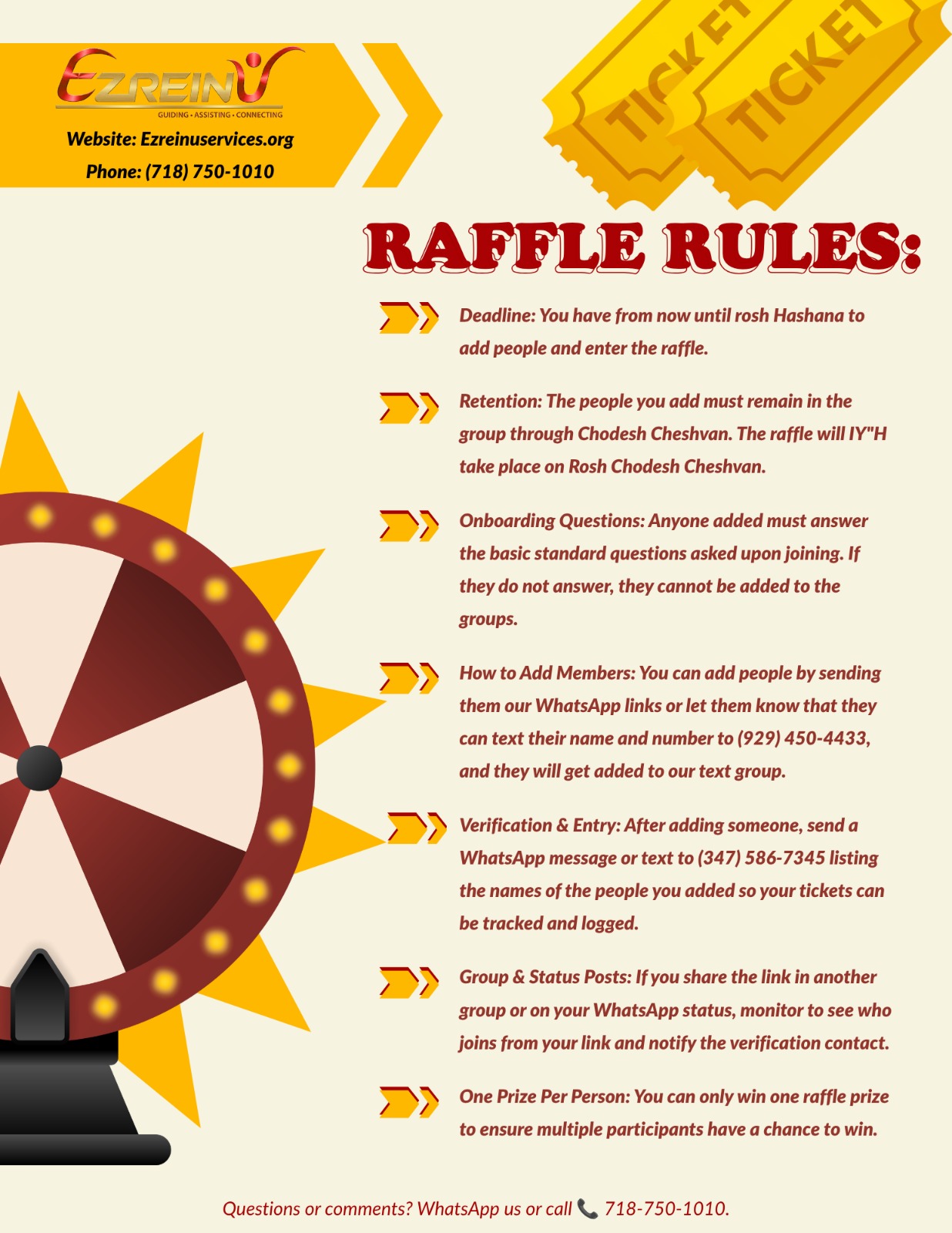
Every 2 people you add = 1 raffle entry!
Your invite could be the reason a family gets the help they need.
Let’s grow our volunteer community together!
Ezreinu Team
💥 EXCITING PRE-TISHREI RAFFLE! 💥
🎉 2 winners will each receive $400 CASH! 👏💵👏
🏆 PLUS: Top recruiter wins $200 CASH! 💵🥁🎉
🎟️ Every 2 people you add = 1 raffle ticket!
📋 Rules & Details:
1️⃣ Deadline: Now through Rosh Hashanah.
2️⃣ New members must stay in the group until Rosh Chodesh Cheshvan. Raffle is IY”H on Rosh Chodesh Cheshvan.
3️⃣ Add people: Share our WhatsApp link [NY, NJ, FL, Baltimore], OR if they want to join our “text group”, have them text name + number to 929-450-4433.
4️⃣ Get Credit: Text/WhatsApp 347-586-7345 with the names of those you added.
5️⃣ Posted the link on a Status/Group? Let us know who joined from your post!
6️⃣ One win per person — we want 2 different winners! 🎉
🎊 Start recruiting and start earning tickets! 🎟️🎊
The more you add, the more chances you have to win! 🏆
Hatzlachah and Tizku L’mitzvos! 🤎
Questions? 🤔 WhatsApp us or call 📞 718-750-1010.
Mrs. Baum was looking for a new school for Tzirel, her 9-year-old daughter with special needs, and a friend had mentioned a local option to her. Mrs. Baum had never heard of this school and wasn’t sure whether it was an appropriate fit for Tzirel, so she called Ezreinu. Ezreinu provided her with detailed information about the program so that Mrs. Baum could make an informed decision.
After undergoing a serious medical crisis, Moishy’s parents wanted to treat him to something very special, but finances were tight. Moishy’s mother reached out to Ezreinu and received information about a helpful grant that they hadn’t known Moishy was eligible for.
Identifying details have been changed to protect client confidentiality.
Liked this post?
Sign up to receive bi-weekly updates to your inbox.