

As a society, we’ve truly come a long way in accommodating special needs in the educational framework. 30 years ago, the average class in any given school had a handful of kids who were considered by teachers and peers alike as “wild”, “weird”, or just plain “not the brightest”. Kids in this category were often asked to leave the classroom due to misbehavior, repeatedly flunked tests and assignments, and across the board were considered unsuccessful.
The past few decades have seen a major shift in attitude and action, both globally and within the frum community. Special ed schools have sprung up by the dozen, and where specialized placement used to be reserved for children with noticeably significant delays, now children with hidden disabilities as well, such as high functioning ASD, ADHD, learning differences, and many other not-immediately-apparent challenges, have the opportunity to attend school in an environment specially designed for kids like them.
Along with all of the wonderful self-contained options that have become available, the attitude within mainstream institutions has shifted as well. Many mainstream schools boast a fully-equipped resource room and a support staff of therapists, special educators, and paras to meet the developmental needs of every child, whether they be academic, behavioral, or social. Baruch Hashem, children who in the past would not have had the necessary support to succeed in school, today have the opportunity to go to mainstream schools like their peers — and thrive.
But a student who has a developmental disability, however bright, talented, and capable the child and however hidden the disability (feel free to call it a challenge, difference, neurodivergence, or whichever term makes you most comfortable) will usually struggle with certain core skills needed for scholastic success, most notably the executive functioning skills.

Whazzat?!
“Executive functioning skills” is a broad term for the stuff the prefrontal cortex of your brain is responsible for. These higher level skills kick in over the course of development, beginning in infancy and only reaching completion at about age 25, and they include planning, task management, time management, initiation, organization, impulse control, emotional regulation, and attention, among other skills.
If you’ve ever:
Filled up the car with gas before going to work,
Cooked dinner for your family, or
Put down your phone to look at your child while he or she was speaking to you (👏),
then you’ve put your executive functioning skills to use!
Many typically developing children struggle with one or two of these skills, but with some strategies and environmental modifications, they can succeed in learning them.
Keep in mind that children with any developmental disability will likely struggle with more than just one or two executive functioning skills at school, and while we will include some great strategies and modifications here which you can use to help your child, it is essential to get to the root of the problem and address that as well so that your child can develop the capability to truly master these skills.
Whether it means going for a proper diagnostic evaluation to gain clarity, considering medication for attention and hyperactivity, or bringing your child to a clinician such as an OT, PT, or SLP who specializes in child development, approaching the child as a whole person instead of merely “fixing” the deficits will be’ezras Hashem help your child achieve more long-lasting success and independence, both in the classroom and in adult life.

Making a Plan
The ability to plan ahead is one of the most basic executive functioning skills. As adults, we do this naturally when we pack our bag in the morning for work, go about our evening routine, or fold a load of laundry. We don’t make a physical checklist for the step-by-step of folding 10 pairs of socks; we do it subconsciously. Pick up sock, rummage through load for its match, hold them side by side to see if they are the same size — or is that just me? — fold, put in basket.
Children who struggle with executive functioning don’t do this process at all — and they have no idea how to go about it. You may tell your child to change into pajamas, and they may have said “okay”, but in reality, they don’t have a clue as to how to get from playing with Playmobil on the floor to a state in which they are wearing pajamas. (By the way, simply recognizing that your child sincerely lacks the know-how will fundamentally change how you parent — and how your instructions are given and heard.)
Luckily, with some practice and patience, planning is a teachable skill.
One popular tool for planning is the Get Ready-Do-Done model.
Here’s how it works: when making a plan, we work backwards: first we name the end goal, then we pinpoint the steps towards achieving that goal, and then we identify how we get ready.
For the planning stage, the device is flipped to read Done-Do-Get Ready. If we go back to the pajama example, it would look like this:
Done: Child is wearing pajamas
Do: Child needs to undress, put on the pajamas, and put his clothing in the hamper. Many children find it helpful to use a visual checklist for regular routines, with pictures or drawings of the child doing each stage of the routine, such as putting on the pajamas, or placing clothing in the hamper. Having a visual checklist like this to refer back to helps the child stay on task and do the next step.
Get ready: Child needs to stop playing with Playmobil and go get pajamas from the pajama drawer.
Now that there is a clear plan to follow, the tool is flipped: Get Ready – stop playing with Playmobil and get my pajamas from the drawer, Do – (using visual checklist) undress, put on my pajamas, put my clothing in the hamper, Done – Whoohoo! I did it!
If your child — like many children — needs some extra, errrr, motivation to get the job done, that positive reinforcement can be the actual end goal. Done – receive ices, Do – get undressed, and so forth.
Another great strategy is using a picture of the accomplished goal, and simply instructing your child to “match the picture”. This can be a picture of a packed backpack by the door, completed homework, or your child dressed for school from head to toe. Visuals are a super powerful tool for helping a child fully understand what the expectations are in a given circumstance, by enabling them to visualize what they need to do.

Working Memory
Working memory (short-term memory), is another executive functioning skill, and it plays an important role when it comes to both planning and task management. A strong working memory provides the ability to remain focused enough to remember and follow an instruction which was just given. This is surprising difficult for many children.
The strategies discussed above, such as using visual checklists and pictures, are one way to reinforce working memory and help your child remain on task. Verbally talking the process through together is essential, it can be beneficial for your child to draw each stage, and many kids even find it helpful to mime or playact the steps in advance.
Prompting your child to “tell me and show me what your plan is” before carrying out a task will help them fully comprehend which steps are necessary to achieve the goal, rather then you, as the adult, just telling them what to do.
Following regular routines consistently — using the aid of a visual checklist — is a great way for your child to learn how to complete tasks independently. Give the routine a catchy name or acronym, and with some practice, your child can get into the habit of following the memorized routine just from hearing the name. For example, if when your child comes home from school, she needs to remember to hang her coat up on the hook and take her homework folder out of her backpack, you might prompt her, “remember CUFO,” and she can follow the formula on her own — Coat Up, Folder Out.

Time Management
Developing an accurate concept of time is a higher-level skill which we don’t expect from very young children. Take the standard “are we theeeeeere yet,” which you are sure to hear from the back seat — approximately 3 minutes after you set out from Brooklyn to the Catskills. With maturity, children begin to conceptualize time more accurately, though for many kids — and adults! — time management remains a struggle.
Utilizing analog clocks is a great way to teach the concept of time. Using a dry-erase marker, you can shade in a section of a clock to help your child visualize how long a task might take. For example, if it is now 7:45 AM, and your child has 15 minutes to eat breakfast before the carpool driver honks outside at 8:00 sharp and then promptly proceeds to drive off, (if you did carpool, you would be MUCH more understanding of kids who have an impressive imagination and the attention span of a goldfish!) you can shade in a pie slice of the clock, by drawing a line along the minute hand, which is currently pointing at the 9, and another line representing where the minute hand will be at 8:00 — on the 12 — and shade the whole area in between the lines.
There are also timers available on the market which show the shaded area of an analog clock shrinking as the minute hand moves, representing how much time is left. Even a child who is not great at reading time can visually process the passage of time when using this method.
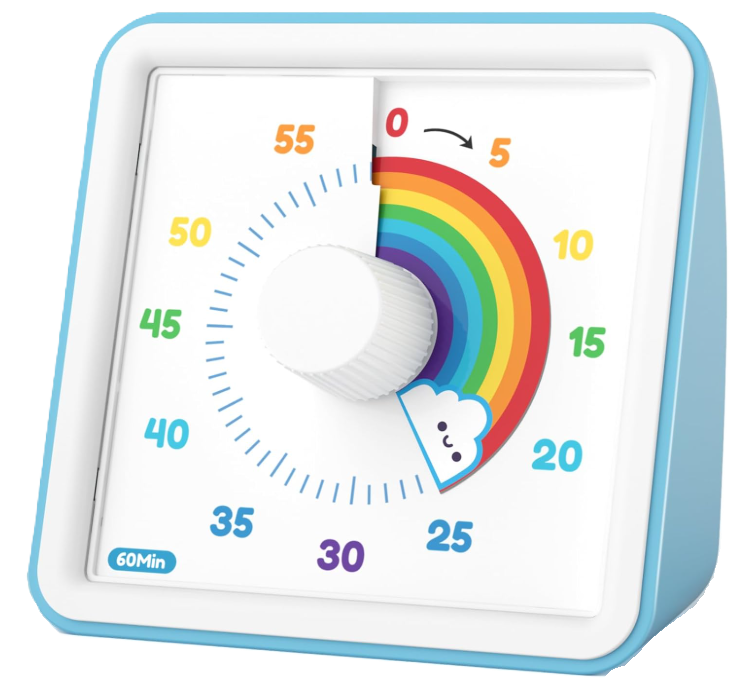
Another way to do this: put a colored sticker on the start time of any task or activity, and another sticker on the end point. As the minute hand circles the clock, your child will be able to physically see how much time passed since the beginning and how much time remains. Some might find it helpful to place a third sticker at the midpoint as a check-in. For example, if your child has to practice kriah reading from 6:00 to 6:10, you can put 3 stickers on the clock: one on 6:00, one at 6:10, and the third at exactly halfway in between, at 6:05. At this point, your child can make sure he is still on task at 6:05 hasn’t gotten distracted, and if he did get distracted, now would be the time to return to the kriah booklet.

These are just a handful of the many tools used to help with executive functioning skills. Each child is unique, and the strategies that work for one often don’t work for everyone. If your child is struggling with executive functioning skills and you are looking for more personalized guidance, reach out to Ezreinu at 718-750-1010 for a referral.
With much appreciation to the following people who shared their knowledge and expertise with us for this newsletter:
Nechama Fried is an executive functioning coach for children and adults based out of Lakewood, NJ. She can be reached at execfuntionpro@gmail.com.
Kira Schuckman, MA, CCC-SLP, is a speech therapist and executive functioning coach for children based out of Lawrence, NY. She can be reached at kiraschuckman@gmail.com.
Danielle Amster, OTR, is an occupational therapist and the founder of Sensory Wellness, a therapy practice with locations in Rochelle Park, NJ; New City, NY; and Brooklyn, NY. She can be reached at danielle@sensorywellness.com.

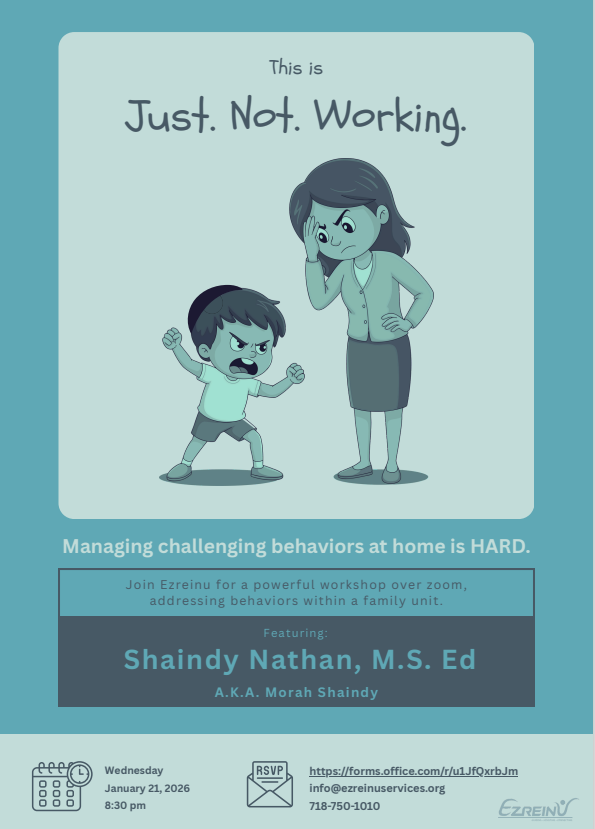
Many parents joined Ezreinu last night for an incredible workshop addressing behaviors in a home setting, presented by Shaindy Nathan, renowned special educator and behavior consultant!
We are looking forward to hosting more educational webinars in the future.

Shoshana, a 16-year-old with ASD and behavioral challenges, needed a time-sensitive dental procedure, but she wouldn’t cooperate long enough in the dentist chair for the job to get done. Her father reached out to Ezreinu and received a referral to an understanding dentist who was able to do the procedure under sedation, special for Shoshana.
For the first time, Shmuly’s parents were considering sending him to a sleepaway camp for the summer. Shmuly is 7 years old and has a developmental delay, and having him home all summer, when he doesn’t have as structured a schedule as he has during the school year, is beginning to get more difficult. Shmuly’s parents contacted Ezreinu and were provided information about several excellent summer camps to choose from, all of which could accommodate Shmuly’s needs beautifully.
Identifying details have been changed to protect client confidentiality.
Liked this post?
Sign up to get bi-weekly updates to your inbox: