What do you need to know about your cutie becoming an adult?
In New York, kids with special needs can usually continue going to school until the age of 21 and receive all board of ed services. But even if your child is still a schoolkid, he or she is legally going to be recognized as an adult from the age of 18.
This means that your child will be able to make medical and financial decisions on his or her own behalf… Unless you put some safeguards into place, allowing you to make those decisions instead.
What could happen without guardianship:
Doctor: Isaac, some of the numbers on your recent bloodwork were a bit high.
Isaac: ‘Kay.
Doctor: I’m going to prescribe a medication for you, Isaac. Would you like it in pill or liquid form?
Isaac: I want pills.
Isaac’s Mom: Isaac can’t swallow pills. Give him the liquid, please.
Doctor: Isaac, your mom says liquid is better. Do you want liquid or pills?
Isaac: I’m grown up. I want pills.
Doctor: Okay, Isaac. Here’s your prescription for pills.
Isaac’s Mom: But I told you, Doctor — he can’t take pills!
Doctor: Sorry, Mom. Isaac is 18 years old and responsible for his own medical decisions.
Oh… I hear. So what now?
If your child isn’t completely capable of understanding nuances at the doctor’s office, in the bank, or in other situations which call for adult decisions, it’s important to maintain some control over these aspects of his or her life.
Though there are alternative options which we’ll discuss soon, the most common route for parents of children with special needs to take is to file for legal guardianship over their child (this type of guardianship is known as Article 17A).
The process tends to schlep, so the sooner you start, the better. In most counties in New York, the earliest age you can file for guardianship is 17.5. However, starting the process several months before that may be a good idea, as getting all of the documents together before filing can take a while.
It’s good to know that while sooner is better, it’s never too late. Even if your child turned 18 last week or last year, you can still file for guardianship.
Will I need a lawyer to file for Guardianship?
Strictly speaking, in New York you do not need a lawyer to file for Article 17A Guardianship. The forms are available online, and you can fill them out yourself and go down to your local Surrogate’s Court to file the documents. (This is the type of court that manages estate planning and guardianship. The judge in Surrogate’s Court is called a “surrogate”.)
That being said, many families do opt to use a lawyer. A lawyer would assist with the bulk of the paperwork and take care of the filing for you.
Call Ezreinu at 718-750-1010 for recommendations of New York attorneys who are experienced in filing for guardianship.
Though legal fees can be prohibitive, keep in mind that if your child is enrolled in OPWDD, you may be able to get reimbursed for legal fees through FSS. (Never heard of FSS? Read up about it in Update from Ezreinu #10 – Alleviate your Financial Burden.)
Nah, I can handle this myself.
Great!
You can use the free official DIY Guardianship Petition Program to fill out the required forms. It will lead you to an external website which will ask interview-style questions and fill out the forms accordingly, which you can then print and file at your local surrogate’s court.
Included in the required forms are some which need to be filled out by other people:
Certifications from either 2 physicians, or 1 physician and 1 psychologist, certifying that due to their intellectual or developmental disability, your child cannot make decisions on their own
Forms signed by all of your child’s close relatives over the age of 18 (such as adult siblings) that they consent to you becoming the guardian
If you would like to appoint a standby guardian in the event that you can no longer act as guardian (we recommend doing this), there is a form for the standby guardian.
… And s’more documents you may be asked to provide:
Your child’s original birth certificate (or a certified copy)
Your child’s most recent psychological report
Your child’s Life Plan
Your child’s IEP
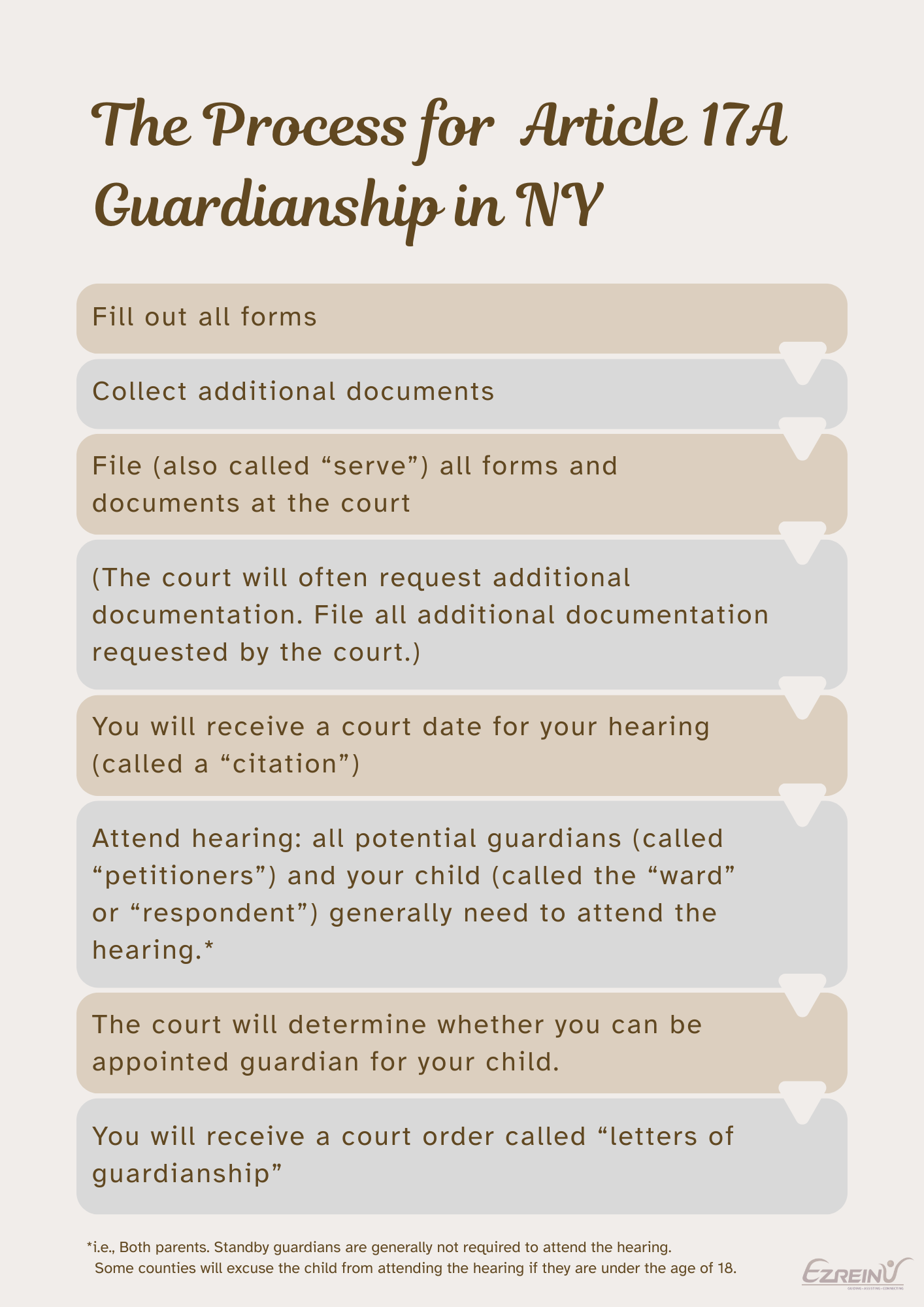
After you file all of the documentation, the court will likely reach out and ask for additional documents. (Different counties require different documents. Some courts will provide you with a court date at the same time as requesting the documents.)
I’m getting dizzy from info-overload.
That … makes perfect sense;)
That’s why we put this simplified Guardianship Process cheat sheet here for you to download:
Woohoo! I got guardianship! Now what?
Continue being the awesome parent you were until now!
Seriously. Being a guardian simply means that you have the ability to continue making decisions on your child’s behalf, like you were doing up until this point.
With much appreciation to Chani Friedman at MM Law for reviewing the above information regarding the guardianship process for accuracy. Chani assists families through the guardianship process and offers group trainings on the subject. She can be reached at 973-508-2628 or chani@mmlawpllc.com.
Alternative Options
Many individuals with special needs are very bright and independent. You may be wondering if guardianship is unfair for a young adult who is capable of making good decisions despite his or her limitations.
There are legal alternatives to guardianship which give the individual more control, and we’ll lay them out for you here, but bear in mind that in all of these options, your child has the ability to override your decision. You might want to think long and hard about whether it is safe for your child to have this ability within their power.
Supported Decision Making
In Supported Decision Making, your child would put together a group of adults who can assist him or her with making important decisions. He or she can consult with these adults, which may include his or her parents, teachers, and mentors, and decide whether or not to follow their advice.
This option does not allow you to make any decisions on your child’s behalf.
Power of Attorney and Health Care Proxy
The Power of Attorney and Healthcare Proxy are documents which both you and your child signs, which state that your child is giving you permission to make decisions on his or her behalf.
The Power of Attorney would give you the right to make legal or financial decisions on behalf of your child, and the Health Care Proxy would allow you to make medical decisions.
These documents are only valid if the individual signing them fully understands what they are signing.
This sounds like a great option for a very high functioning individual who wants to be independent, but there are two potential issues to consider before going ahead:
Although you can use these documents to make decisions or grant consent on your child’s behalf, your child can disagree, and his or her wishes would legally need to be respected over yours.(For example, you may want to use your Power of Attorney to sign on a financial transaction that would benefit your child, but your child can say that they don’t want you to sign, and you won’t be able to.)
Someone may challenge these documents at a later date and claim they are not valid, if they feel that your child didn’t fully understand the scope of the rights they were signing over to you. (For example, a doctor may tell you that you cannot use your power as Health Care Proxy to give consent to for a medical procedure for your child, as your child didn’t understand what he was signing and therefore never gave you permission to make that decision on his behalf.)
Sample Power of Attorney and Health Care Proxy documents:
The Birnbaums were at their wits’ end. Their daughter Shana, a cute third grader in mainstream school, was displaying all sorts of confusing behaviors. Her teacher, principal, and OT all had different suggestions of what might be at play — sensory issues, ADHD, a learning disability, visual processing issues… The list went on, but nothing seemed to be the answer. At a loss, the Birnbaums reached out to Ezreinu, where their story was heard from beginning to end, and for the first time, they got clear, logical instructions for which areas they should look into, and which professionals were most suited to evaluate her.
The Berman family were travelling in from another state to attend a family simcha in New York. They were apprehensive about how it would work out with Shaindy, their 6-year-old daughter with special needs, who needed constant supervision and entertainment. Someone suggested that they reach out to Ezreinu, and they decided to give it a try. To their delight, they were sent a volunteer to take care of Shaindy for the duration of the simcha, enabling them to enjoy rare family time unencumbered.
Identifying details have been changed to protect client confidentiality.