
The therapy market is made up of a varied and colorful mix of both the traditional, scientifically-proven treatment methods and the slightly more esoteric modalities, often referred to as “alternative therapies”.
While seeking intervention for their children with special needs, some parents prefer to remain within the parameters of the safe, tried-and-true, PT-OT-SLP regimen, while others like to try out alternative options which they feel their children may benefit from. (There’s nothing wrong with either approach; as a parent, you were granted the unique wisdom to help your child reach their potential!)
“Alternative therapy” is a very broad term which encompasses both modalities based on the ideas of energy healing (such as acupuncture or kinesiology — which you might have heard referred to as “Chinese medicine”) AND modalities based on scientific hypotheses and research, which don’t have enough supporting research backing it to be considered evidence-based. (An example of a popular, widely-accepted therapy in this category is MNRI, or Reflex Integration, which, despite it’s efficacy, is not considered evidence-based by the world of medical science. You can read more about Reflex Integration in our previous newsletter here.)
Craniosacral therapy falls into this last category as well; while not considered an evidence-based treatment, it is still based on actual observations of the human anatomy and systems.
So, what’s the science behind it?
Craniosacral Therapy, also known as CST, is based on the theory of the craniosacral rhythm — that the skull expands and contracts rhythmically. (Medical science says that the bones of the skull are fused, but osteopaths point out that if you study the anatomy of a skull, that’s not true: the various bones of the skull fit together like a jigsaw puzzle, kind of like other joints in the body, which allow them to expand and contract very slightly — a movement which can be detected by palpation, when the provider rests their hands on the patient’s head with very gentle pressure).
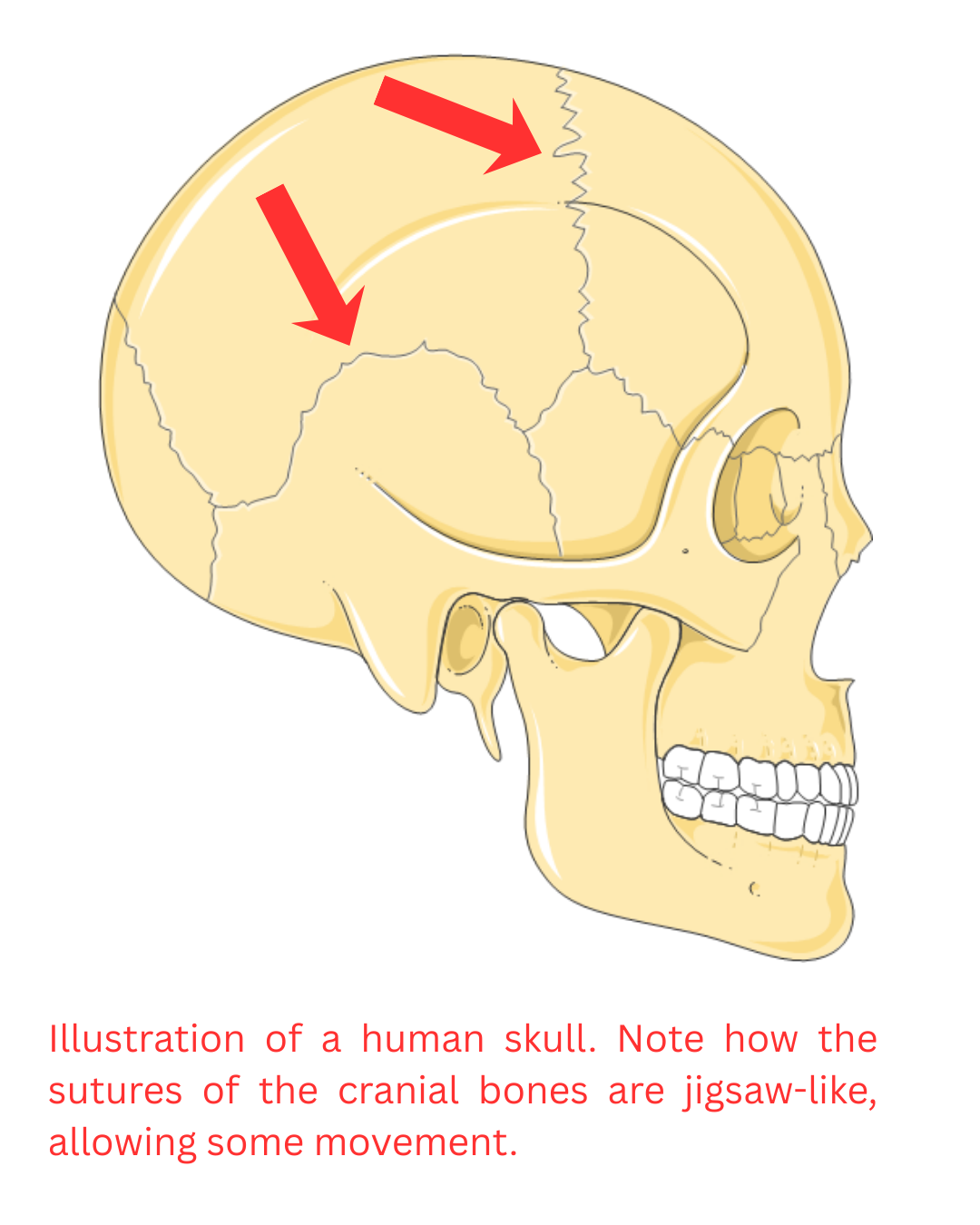
This expansion and contraction is thought to occur as a result of the movement of Cerebral Spinal Fluid (CSF). The flow of CSF nourishes the brain and spinal cord, which are the center for many of the body’s systems, including the all-important nervous system. An experienced craniosacral therapist can palpate the patient’s craniosacral rhythm and detect if there are restrictions or blockages that are not allowing the rhythm to function smoothly. They then can apply various forms of gentle, non-invasive pressure, positioning, and manipulation to get the craniosacral rhythm back in sync.
Got it. What does it help with?
Craniosacral therapy is used to relieve tension and anxiety, migraines and headaches, jaw issues (such as TMJ), muscle pain and stiffness, vertigo and dizziness, and more.
People find craniosacral therapy extremely relaxing and soothing, as it literally eases tension.
Many craniosacral therapists also work on nerve stimulation in other areas where the patient is experiencing a difficulty or delay, such as the legs for walking, oral nerves for feeding, or the prefrontal cortex for executive functioning.
There are also some therapists who practice craniosacral therapy together with a similar method known as visceral manipulation therapy, which works on the organs, manually relieving restrictions and restoring normal function.
Important note: Because craniosacral therapists work on intracranial (head/brain) pressure, craniosacral therapy can be dangerous for patients who recently had a head, neck, or spine injury or surgery, aneurism, stroke, meningitis, or lumbar puncture. However, after some time has passed, and ONLY with a doctor’s clearance, these patients may actually benefit from craniosacral therapy.
I’m tempted to try this.
Before running to the first craniosacral therapist who your friend, sister, or neighbor took their child to and saw maaaaaajor results, you might want to give more thought to the overall situation.
Here are some helpful questions to consider:
-
What issue is my child experiencing?
We all know people who, out of desperation, try every intervention under the sun; please don’t do that to yourself or your child. If you want to see success, make a plan. Ask yourself if the goal is progress, comfort, or something else, and refine the issue until you have a clear (and medically realistic) goal set for your child. (“I want to see Chaim walking independently.”) Be suspicious of therapists who tell you they can “heal” or “fix” your child’s special needs completely. Yes, as mommies, we want to kiss the booboos away… But let’s try to remember that our goal is to help our children make as much progress as possible with the tools that Hashem gave them.
-
Is my child making progress with the intervention he or she is currently receiving?
Figured out what it is that you’re trying to accomplish? Great! Now you have to see whether you are going in the right direction. If your child is already receiving services for this issue and is making progress, it may not be necessary to add on another intervention. Slow but steady progress is a positive thing. However, if you feel your child can benefit from an additional boost, you may want to consider an alternative option like craniosacral therapy as an adjunct therapy — in addition to regular therapy. (If your child is NOT making progress in regular therapy, you may want to consider changing providers. It’s common to think, this physical therapy is not working at all for my child, maybe I should just give up and go for alternative therapies instead, while the fault may actually lie with the provider rather than the modality.)
-
Is the therapist I want to use properly educated and trained?
An osteopath, chiropractor, nurse, physical/occupational/speech therapist, or massage therapist can all get trained in craniosacral therapy.
Make sure you are using a provider who has a general medical or therapeutic background in addition to providing craniosacral therapy. Be aware that there are many craniosacral therapists who aren’t trained in any other modality and don’t have a medical background. Craniosacral therapists work directly with the sensitive muscles and tissue surrounding the brain and spinal cord, which means that someone who doesn’t have a medical or therapeutic background can inadvertently cause harm.
-
Does the therapist I want to use specialize in the specific issue I want to address?
Ask the therapist what their background is. Different providers will be better for different patients, based on their background. For example, a chiropractor might be more experienced in relieving muscle pain, while a physical therapist might be better for addressing balance issues.
-
Does my child have full body sensation? Is my child capable of clear communication?
If your child lacks sensation in certain body parts, it’s not advisable to have craniosacral therapy applied to those areas, as the child will not know if something hurts or feels “off” and ask the therapist to stop. For the same reason, it may not be an advisable therapy for a child with limited verbal or communicative abilities.
-
Can I afford it financially?
Craniosacral therapy is generally not covered by insurance, and, like in all other fields, private sessions are costly.
-
Can my child (and I) afford it emotionally and practically?
All children are under pressure to perform and accomplish, and children with special needs, with the countless additional adults in their life who encourage, teach, and support them, feel it even more. The strain of schlepping to another weekly appointment means more traveling, more cooperation, and less time to just be a kid. That’s a high price to pay for additional therapy that will only possibly help. We’re not saying not to do it; we’re just encouraging you to consider all factors so that you can make the best decision for your child.*
*to read more about finding a balance with therapy, read our previous newsletter on the topic here.
I want to give craniosacral therapy a shot. Who should I call?
Reach out to the Ezreinu office at 718-750-1010 for a referral for a craniosacral therapist! 🟦
With much appreciation to craniosacral therapists Shira Korngold and Melek Nathan for generously sharing their knowledge with us for this newsletter.
They can be reached through Ezreinu.
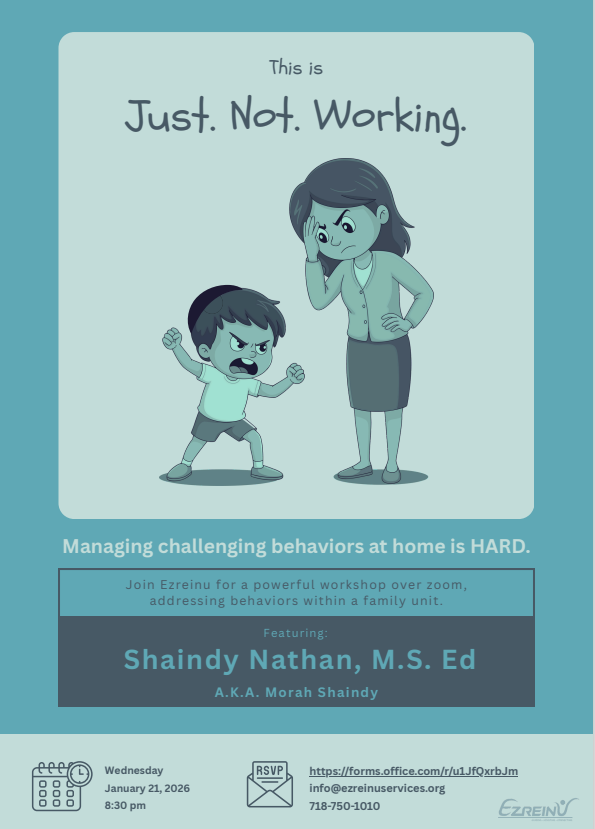
We are excited to inform you of Ezreinu’s upcoming free WEBINAR on the topic of Behaviors in a Family Unit, presented by Shaindy Nathan, M.S. Ed.
The webinar will iy”H take place on Wednesday, January 21st, at 8:30 PM. As of now, the webinar will not be recorded. RSVP is required — click the button below to sign up!
The Steinfelds were planning a mid-winter family getaway to Florida. They booked tickets and a hotel and planned the itinerary down to the last detail, but there was one issue that still wasn’t ironed out: what would they do with Chayala, their 23-year-old daughter with special needs? Chayala is fairly independent, and they would even be happy to take her along on the trip, but she refuses to change her routine and miss even one day at day hab. Staying alone in the house wouldn’t be safe for her. Mrs. Steinfeld called Ezreinu, and they arranged for a responsible adult to sleep in the house together with Chayala, enabling the Steinfelds to enjoy their trip while Chayala happily maintains her regular schedule.
Shalom, a friendly second grader, was struggling with speech. He qualified for speech therapy in school through the DOE, but his cheder didn’t have an available speech therapist. His father reached out to Ezreinu and received a referral for an excellent speech therapist who could work with Shalom after school hours instead.
Identifying details have been changed to protect client confidentiality.
Liked this post?
Sign up to get bi-weekly updates to your inbox: